Don’t learn golf on YouTube
Short version: YouTube is a wonderful place. It has cat videos, sourdough tutorials, and people restoring rusty tools with calming background music. It is not, however, a good place for beginner golfers to learn how to play golf.
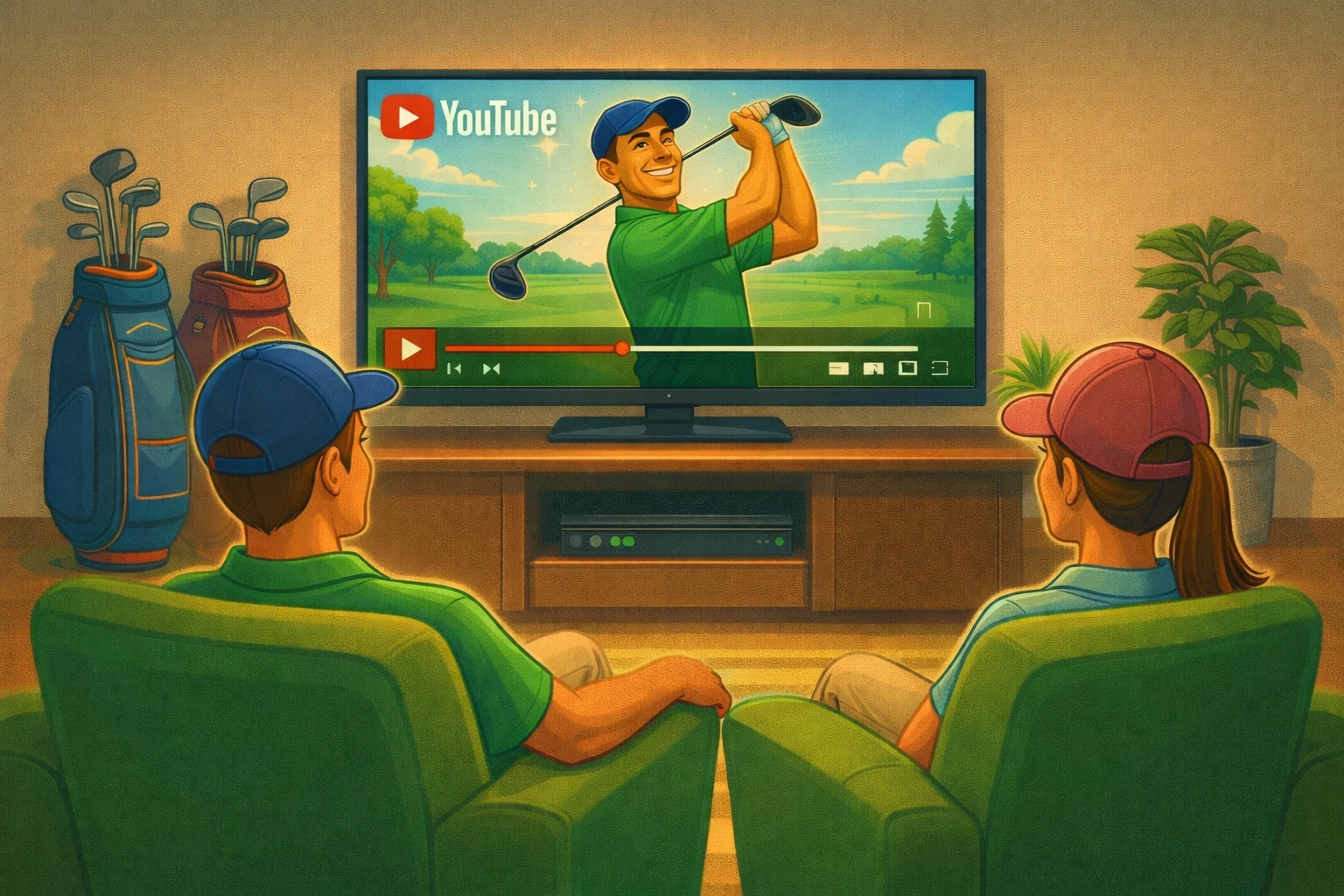
Long version: Keep reading. Bring a coffee. Possibly a snack. This one’s for every hopeful beginner who typed “how to swing a golf club” into YouTube and emerged three hours later more confused than when they started.
“I watched 47 golf videos last night. I now know everything… except how to hit the ball.” — Every beginner golfer, ever
Table of Contents
- The irresistible temptation of YouTube golf
- The firehose problem: too much information
- When experts violently disagree
- Golf tips without context (aka chaos)
- Why copying pros is a terrible idea
- The fatal flaw: zero feedback
- How YouTube quietly kills confidence
- What beginners actually need instead
- When (and how) YouTube can be useful
- Final thoughts (and a small intervention)
The Irresistible Temptation of YouTube Golf
YouTube promises everything beginners crave:
- Free lessons
- Instant improvement
- “Fix your slice in 5 minutes.”
- “One move the pros don’t want you to know.”
It feels productive. You’re not just scrolling — you’re learning. Or at least that’s what your brain tells you while your swing quietly gets worse.
YouTube golf content is designed to be clickable, not teachable. And those are two very different goals.
“Free” is expensive when it costs you time, confidence, and progress.
The Firehose Problem: Too Much Information, Too Fast
Beginner golfers don’t lack motivation. They lack filters.
You search for: “How to swing a golf club.”
You receive:
- Grip pressure philosophies
- Seven different backswing positions
- Launch monitor data
- Hip depth analysis
- Three drills involving alignment sticks, towels, and existential dread
This is like trying to learn how to drive by watching Formula 1 pit stop breakdowns.
Your brain doesn’t know what matters yet — so it treats everything as urgent.
Confusion doesn’t feel like confusion. It feels like “I just need one more video.”
When Experts Violently Disagree
On YouTube, you will hear the following statements — often back-to-back:
- “Keep your head absolutely still.”
- “Let your head move naturally.”
- “Swing in to out.”
- “Never think about swing path.”
- “Hands lead the club.”
- “Release the clubhead early.”
All of these tips might be correct. They are just not correct for you, right now, all at once.
Golf instruction without sequence is noise.
The problem isn’t bad advice. It’s good advice at the wrong time.
Golf Tips Without Context (aka Chaos)
YouTube golf thrives on isolated tips:
- One drill
- One feeling
- One magic move
But golf is a system:
- Grip affects face control
- The setup affects the swing path
- Balance affects contact
- Decision-making affects the score
Beginners don’t need fixes. They need frameworks.
Without context, you end up stacking random swing thoughts like unstable Jenga blocks — and wondering why everything collapses on the 3rd hole.
Why Copying Pros Is a Terrible Idea
Let’s talk about the most dangerous sentence in beginner golf:
“I saw Tiger do this…”
Professional golfers:
- Have elite athletic ability
- Train for thousands of hours
- Have bodies adapted to golf
- Practice under supervision
You, meanwhile, might:
- Sit at a desk all day
- Stretch “sometimes”
- Play once a week (when life allows)
- Be learning what “par” means
Trying to swing like a tour pro as a beginner is like copying an Olympic gymnast’s warm-up and wondering why your spine filed a complaint.
Pros break rules because they earned the right to. Beginners need the rules first.
The Fatal Flaw: Zero Feedback
This is the big one.
YouTube cannot:
- See your grip
- Correct your posture
- Notice your balance
- Adjust your misunderstanding
You might be doing the drill completely wrong — and reinforcing it for weeks.
Golf is a game of small errors with big consequences. Without feedback, you don’t improve — you practice mistakes.
How YouTube Quietly Kills Confidence
YouTube doesn’t yell at you. It does something worse: it makes you feel like:
- You should be better by now
- You’re missing something obvious
- Everyone else “gets it” faster
Every video shows perfect swings, clean contact, and effortless improvement. Your reality shows topped shots, fat shots, confusion, and occasional existential crises.
This gap quietly erodes confidence — and confidence is everything in golf.
What Beginner Golfers Actually Need
Beginner golfers don’t need hacks. They need:
- A clear mental map of the game
- Simple fundamentals in the right order
- Permission to be bad (at first)
- Feedback that matches their level
They need structure, not scroll fatigue.
When (and How) YouTube Can Be Useful
YouTube isn’t evil. It’s just misunderstood.
YouTube works best when:
- You already understand the basics
- You’re looking to reinforce a concept
- You know what problem you’re solving
Used after structured learning, YouTube becomes a supplement — not a substitute.
Think of it as seasoning, not the meal.
Final Thoughts (and a Small Intervention)
If you’re a beginner golfer, this is said with love: Put the algorithm down. Pick the basics up.
Golf is hard — but it’s not chaotic. It only becomes chaotic when learning has no structure.
Learn the why before the how. Build fundamentals before fixes. And save YouTube for later — when it can actually help.
Your future self (and your scorecard) will thank you.
Now go practice. Calmly. With purpose. And maybe without autoplay.