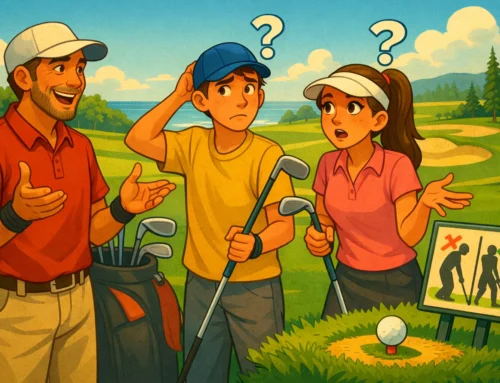
The Mental Challenges of Golf
Why This Game Is Mostly Played Between Your Ears
Golf is a mental game. Sure, you swing a club, hit a ball, and walk around a nicely landscaped park while slowly questioning your life choices. But if you’ve ever stood over a three-foot putt with shaky hands or tried to carry water after dunking two balls already, you know the real battle isn’t physical—it’s psychological.
This post dives deep into the mental challenges of golf: how to handle hazards, how to prepare for tough shots, how to focus on the task at hand, and how to make the right choices when your brain wants to panic. We’ll keep things light, conversational, and just self-aware enough to laugh at ourselves.
Grab a coffee (or a swing oil beverage of choice), because this is where golf meets the mind.
Table of Contents
- Why Golf Is a Mental Game
- Pressure: Golf’s Invisible Hazard
- Focus and the Art of Staying Present
- Decision Making on the Course
- The Mental Side of Hitting Over Hazards
- Preparing to Hit Out of Trouble
- Fear, Confidence, and Swing Thoughts
- Pre-Shot Routines and Mental Consistency
- Letting Go of Bad Shots
- Final Thoughts: Winning the Battle Upstairs
Why Golf Is a Mental Game
Golf is one of the few sports where the ball just sits there… menacingly… judging you. No defender is rushing you. No clock is ticking. You have all the time in the world—and somehow that makes it worse.
In most sports, instinct takes over. In golf, thinking is unavoidable. You think about:
- Your swing
- The wind
- The last bad shot
- The water hazard ahead
- What your playing partners think of you
- Whether you should’ve taken up pickleball instead
“Golf is played on a five-inch course—the distance between your ears.”
The mental challenges of golf come from managing all that internal noise while still making a confident, committed swing.
Pressure: Golf’s Invisible Hazard
Pressure in golf doesn’t announce itself. It just shows up quietly and ruins everything.
You feel pressure when:
- You’re hitting first on the tee
- You’re trying to break a personal best
- You’ve told your friends you’ve “been playing pretty well lately”
The trick is understanding that pressure isn’t a sign something is wrong. It’s a sign you care.
Great golfers don’t eliminate pressure—they accept it. They acknowledge the nerves, then shift focus back to the process instead of the outcome.
Focus and the Art of Staying Present
If golf rewarded daydreaming, we’d all be scratch golfers.
But golf demands focus—on one shot, at one moment, with one clear intention. That’s hard when your brain wants to replay your triple bogey from two holes ago or fast-forward to the clubhouse beer.
To stay present:
- Focus only on the shot in front of you
- Pick a very specific target
- Breathe before you swing
“You can’t hit the shot you just messed up, and you can’t hit the one coming next.”
The mental challenge of golf is learning to live in the now—at least for 4.5 hours.
Decision Making on the Course
Golf constantly asks you one simple question:
“Is this a smart shot… or an ego shot?”
Choosing the right club, the right line, and the right strategy is a mental skill. Most bad shots start with bad decisions, not bad swings.
Good decision-making in golf means:
- Playing to your strengths
- Avoiding unnecessary risks
- Accepting boring golf when needed
Boring golf, by the way, is often very good golf.
The Mental Side of Hitting Over Hazards
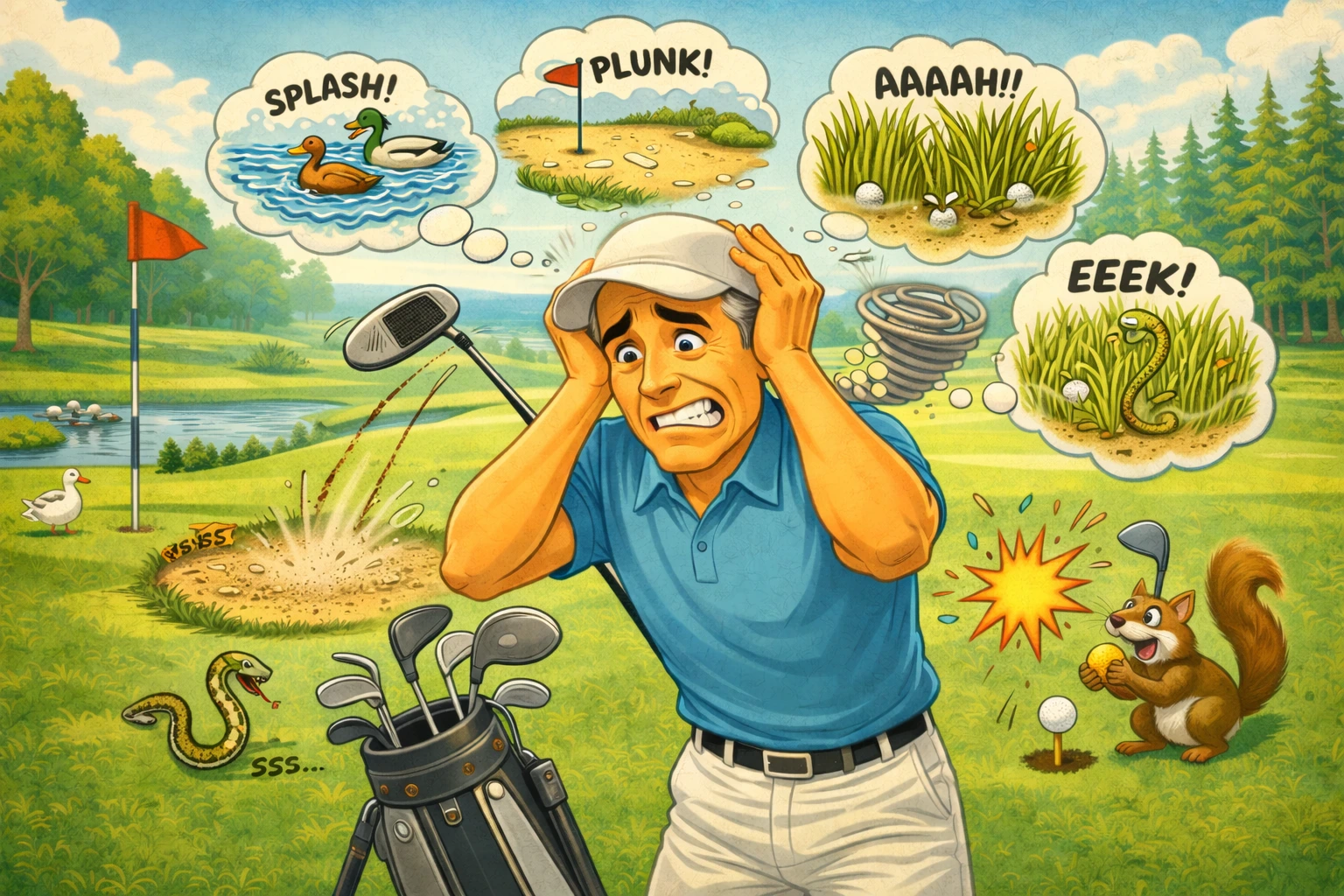
Water hazards, bunkers, trees—these aren’t just physical obstacles. They’re psychological traps.
The moment you think, “Don’t hit it in the water,” your brain hears one thing:
“Hit it in the water.”
To handle hazards mentally:
- Pick a target beyond the hazard
- Commit fully to the shot
- Accept the risk before swinging
Hesitation is the real hazard. A committed swing—even if it misses—is almost always better than a fearful one.
Preparing to Hit Out of Trouble
Eventually, you will miss. A lot. Welcome to golf.
The mental challenge isn’t getting into trouble—it’s how you react once you’re there.
When hitting out of trouble:
- Lower your expectations
- Choose the safest option
- Focus on damage control, not hero shots
“The smartest shot is often sideways.”
Golf rewards patience, humility, and knowing when to live to fight another hole.
Fear, Confidence, and Swing Thoughts
Fear creeps in when confidence disappears. And confidence in golf is fragile.
One bad swing can erase five good ones if you let it.
To build confidence:
- Stick to simple swing thoughts
- Trust your practice
- Focus on tempo, not mechanics
The mental side of golf isn’t about perfection—it’s about belief.
Pre-Shot Routines and Mental Consistency
Your pre-shot routine is your mental anchor.
It tells your brain, “We’ve done this before. Relax.”
A good routine:
- Stays consistent
- Includes visualization
- Ends with commitment
When nerves show up, routines keep you grounded.
Letting Go of Bad Shots
Bad shots happen. Great golfers let them go faster.
Holding onto mistakes creates tension, frustration, and more mistakes.
Try this mental reset:
- Acknowledge the mistake
- Learn one thing
- Move on before the next shot
“The next shot deserves your full attention.”
Winning the Battle Upstairs
Golf is hard. Not because the swing is complicated, but because the mind is.
The mental challenges of golf—focus, decision-making, confidence, and emotional control—separate good golfers from frustrated ones.
You don’t need a perfect swing. You need a clear head, a simple plan, and the ability to laugh when things go sideways (sometimes literally).
Master the mental game, and golf becomes more fun, more consistent, and way less stressful. And if not… well, at least the walk is nice.