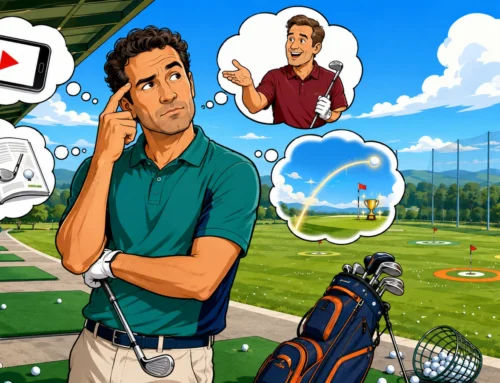
Why Golf Knowledge Matters Before You Step on the First Tee
You can strike the ball well on the practice ground and still walk off the course wondering why your score does not reflect your ability.
That gap is familiar to golfers at every level. You may have a sound swing, putt reasonably well and have enough good shots to believe you should score better. Yet your rounds remain inconsistent or harder than they need to be.
The problem may not be another missing swing thought. It may be that you stepped onto the first tee without a clear golf game plan.
Golf is a game of decisions, not just swings. The decision matters as much as the execution.
Golf is a game of decisions, not just swings
Every golf shot has at least two important parts. First, you decide what you are trying to do. Then you try to execute it.
Technical improvement matters, and professional instruction can be extremely valuable. But technique cannot make the decision for you. Your swing does not decide:
- where you should aim;
- which club gives you the most sensible next shot;
- whether the flag is worth attacking;
- how much risk is acceptable;
- what to do after a poor drive; or
- whether a good result came from a poor choice.
Those questions belong to golf knowledge and course strategy. A technically good shot played towards the wrong target can create trouble. An imperfect shot played towards a sensible target may leave you in a manageable position.
The problem with learning golf in fragments
Many amateur golfers learn golf as a collection of separate pieces. A lesson improves one part of the swing. A video offers a chipping tip. A friend suggests a different club from the tee. Each fragment may contain something useful. The difficulty is knowing how the pieces fit together.
When knowledge remains fragmented, the golfer often reacts instead of seeing the situation, comparing the options and making a decision:
- “I normally hit driver here.”
- “I should be able to reach.”
- “I need to make up for the last hole.”
- “I will aim at the flag and hope.”
- “I hit this club well once.”
Hope is not a game plan.
A connected understanding gives individual skills a purpose. For more on the limits of disconnected advice, read why you should not learn golf on YouTube.
What a golf game plan should do
A golf game plan does not mean predicting every shot. It gives you a framework for responding. Before the round, consider:
- which tees suit your current game;
- which clubs you trust most;
- where the main trouble is on difficult holes;
- which holes require patience;
- where your normal shot pattern gives you room;
- what playing objective is realistic today; and
- how you will respond after a mistake.
Choosing suitable tees is part of this preparation, not a test of status. Read Which Tee Should You Play From.
A practical example: the opening hole
Imagine a long opening par 4 with a fairway bunker on the right and trees on the left. Without a plan, the automatic choice may be driver. But is the real objective maximum distance, or a position that keeps the next shot manageable?
If your normal driver pattern brings both hazards into play, a shorter club towards the wider section may be smarter. If the next shot remains too long for a comfortable attempt at the green, place the ball where the following shot becomes simple. Three manageable decisions can be better than demanding one perfect shot.
For a deeper look at this planning, read Course Navigation Basics.
Five questions to ask before every shot
- What situation am I facing?
Consider the lie, distance, wind, slope, hazards, landing area and flag position. - What are my realistic options?
You may attack, play towards the safe side, lay up or return the ball to play. - What happens if I miss?
Where is the trouble, how severe is it and does your target allow for normal variation? - Is the reward worth the risk?
Playing the percentages means accepting risk for a clear reason. Read Playing on the Edge in Golf. - Can I commit to this choice?
Once the decision is sensible, stop negotiating and give the shot your full attention.
A poor result does not always mean the decision was poor
A sensible target can produce a poor result after imperfect execution. A dangerous target can produce a good result through luck. If you judge every decision only by the result, luck becomes your teacher.
Review the choice and the execution separately.
- Was the choice sensible for my ability and the situation?
- How well did I execute the chosen shot?
Technical problems can be taken to a golf professional. Decision patterns can be improved through knowledge, preparation and honest reflection.
Knowledge makes golf more enjoyable
A game plan will not remove bad shots. Mistakes are part of golf. What knowledge can remove is some of the confusion.
- You spend less time guessing.
- You feel less pressure to play shots you do not own.
- You recover from mistakes with a clearer purpose.
- You recognise good decisions even when execution is imperfect.
- You become more involved in the game rather than reacting to every result.
If a shot puts you in difficulty, solve the situation before trying to recover the score. Read What to Do When You Are in Trouble.
Start before the first tee
Before your next round, ask:
- What kind of golf can I realistically play today?
- Where can I make the course simpler?
- Which risks are worth taking?
- What will I do after a poor shot?
- What is my decision process before every swing?
Write down three simple principles:
- Choose a target that allows for your normal miss.
- Do not follow one mistake with an unnecessarily risky decision.
- Decide first, then commit to the shot.
You do not need to know everything about golf before you play. But you need more than a collection of shots. You need an understanding of how to use the game you have.
Learn first. Play smarter. Have more fun.
Your next step: Create a three-point golf game plan before your next round and use the five questions before every important shot.
Keep reading