Playing on the Edge in Golf: Why Risky Decisions Cost More Shots Than You Think
Some rounds of golf feel exciting while you are playing, but disappointing when you finally add up the score. You tried the bold shot, attacked the tight pin, pulled driver when accuracy mattered, and maybe even attempted one heroic recovery from the trees. It felt brave. It felt fun. But somehow, by the 14th hole, the round had quietly turned into another score you did not really want to talk about.
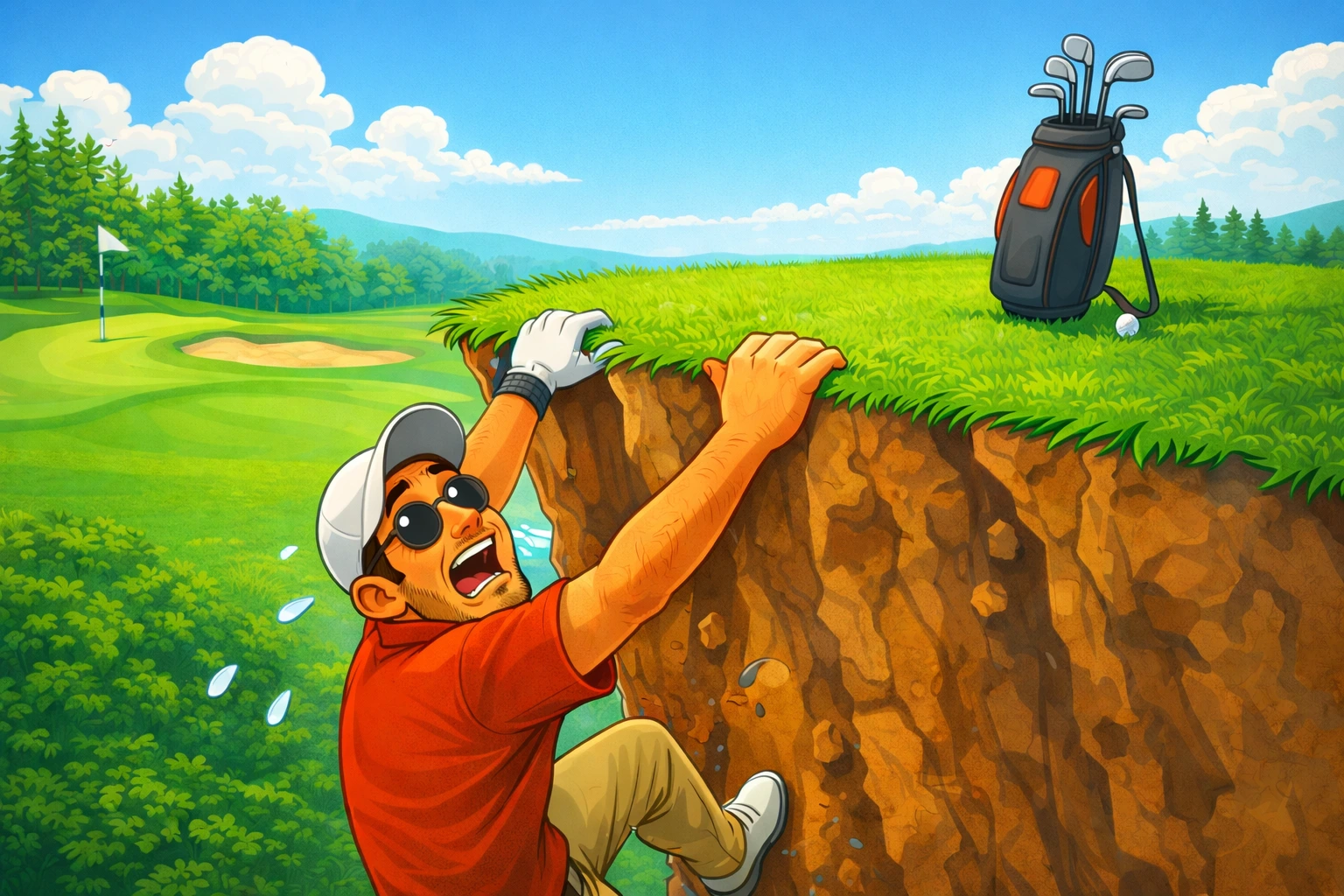
That, in simple terms, is what we call playing on the edge.
Key takeaways
- Playing on the edge means choosing shots with too little margin for error for your current skill level.
- Many golfers lose shots because of poor decisions, not because of terrible swings.
- Golfers often remember their best shots and forget how often the risky version fails.
- Smart scoring is about matching the shot, club, and target to your real patterns.
- The goal is not to play boring golf. The goal is to choose aggression when the odds are actually in your favour.
What “playing on the edge” actually means
We see this all the time. Golfers often lose strokes not because of bad swings, but because of poor decisions. They pick shots that push their limits. These choices feel bold and fun at first, but they often lead to penalty shots, awkward lies, tough recoveries, and big numbers on the scorecard.
What makes this frustrating is that many of these golfers could score better right now. Their scores are not always held back by ability. More often, they are held back by choices that demand more than their current skills can reliably deliver.
Scoring well in golf means picking shots you know you can pull off, not trying to prove you can hit a shot you only make once in a while.
Playing on the edge is when you choose shots, targets, clubs, or strategies that leave almost no margin for error at your skill level. That last part matters. A tour player aiming over a lake may not be taking a reckless risk. But if a 22-handicapper tries the same shot just because it worked once last summer, that is playing on the edge.
Golf is a game of probability. Every shot can turn out differently. Skilled players have tighter patterns and more predictable outcomes. Newer golfers and higher handicappers usually see more variation. If your 7-iron sometimes goes straight, sometimes thin, sometimes right, and sometimes heavy, aiming at a six-yard gap between water and a bunker is not confidence. It is wishful thinking dressed up as strategy.
This is where judgment often fails. Golfers fall in love with the best possible shot and forget to plan for the most likely shot. On the course, those are often very different things.
Why golfers drift toward risky decisions
Golfers do not usually start the day planning to make bad choices. Most risky decisions happen slowly. A little ego appears. A little frustration builds. A TV shot pops into the mind. Then suddenly, instead of choosing the sensible play, the golfer chooses the exciting one.
1. Ego sneaks into club selection and target choice
Most people do not enjoy playing safe. Some golfers would rather take a big risk and fail than play a simple shot and succeed quietly. Hitting a 7-iron to the middle of the green is not as exciting as trying to land an 8-iron close to a tight pin. Lying up does not feel as heroic as going for it.
But the scorecard does not care about style. It only counts shots.
2. The highlight reel becomes the strategy
Golfers remember the one amazing 3-wood they hit over water. They often forget the four that finished in the water, short, or off to the side. Our minds create a highlight reel and use it as proof. But your handicap is based on every shot you hit, not just the best ones. It is the full-season box set, not the trailer.
3. Professional golf makes risky shots look normal
Watching professional golf can make difficult shots seem much more normal than they really are. Tour players have speed, control, spin, experience, and practice time that most club golfers lack. Seeing a professional hit a high flop shot over a bunker is fun to watch. Trying the same shot from a poor lie with a double bogey already lurking is a very different story.
4. Golfers confuse capability with consistency
This is one of the biggest points in golf improvement. Many golfers can pull off a difficult shot now and then. But your score depends much more on what you can do consistently. The course rewards decisions based on skills you can repeat, not rare moments of brilliance.
Common examples of playing on the edge
It helps to see these decisions in real situations. Here are some classic examples of what playing on the edge often looks like during a normal round.
Using a driver when accuracy matters more
A driver can leave you with shorter approach shots, but it can also bring out-of-bounds, bunkers, trees, penalty areas, and difficult angles into play. If you tend to hit the driver all over the place and the hole is narrow, that extra distance may cost more than it saves.
Aiming at every flag
Firing at the flag sounds bold and confident, but many pins are placed near trouble. If you do not have precise distance control and direction control, it is usually smarter to aim for the larger, safer part of the green.
Trying to carry trouble at full stretch
If you need your absolute best shot just to clear water, a bunker, or a corner, you are not really making a plan. You are hoping for the best. Sometimes hope works. Over 18 holes, it usually sends you an invoice.
The miracle recovery shot
You are stuck behind a tree with a small gap, a poor stance, and no realistic line. The smart move is to punch out to safety. The risky move is to try a hero shot around the branches and still go for the green. One choice keeps bogey possible. The other can lead to big numbers and some colourful language.
The fancy short-game shot
Some golfers look down on the simple chip or bump-and-run because they have watched too many highlight reels. But the low-running shot is often easier, more predictable, and more forgiving than a high, delicate rescue shot.
Trying to make every putt
Good players know when to be aggressive. Golfers playing on the edge often blast 25-foot putts past the hole while chasing a miracle. Most of the time, the smarter goal is to avoid the three-putt. That may not sound exciting, but it saves scores.
How risky decisions quietly ruin a score
Here is the tricky part: playing on the edge does not always ruin your round immediately. Sometimes the first risky shot works. That is exactly why golfers keep trying it.
But over 18 holes, golf exposes decisions you cannot count on.
- One aggressive tee shot can lead to a penalty.
- One risky approach can finish in a bunker or short-sided lie.
- One impossible recovery can turn into a double bogey.
- One reckless putt can turn a par chance into a bogey.
Add those moments together, and you can lose five, seven, or even nine shots without feeling like you hit the ball badly. Many golfers say, “I hit it well, but still scored badly.” They probably did. The problem was that they kept choosing situations where even a good swing could not fully protect the score.
Golf is not just about making good swings. It is also about putting yourself in situations where your swing has a fair chance to succeed.
Smart aggression vs reckless play
Scoring well is about balancing risk. There is a big difference between smart aggression and reckless play.
Smart golf is not timid. Good scoring players can be aggressive. Smart aggression means choosing a bold shot when the odds are in your favour. Maybe you have a perfect lie. Maybe the hazard is not really in play. Maybe the wind helps. Maybe your miss still leaves you with a simple next shot. Maybe you have practised that shot enough to trust it.
Reckless golf is different. Reckless golf means choosing the exciting option just to satisfy your ego, mood, or frustration, even when the likely downside is obvious. That is aggression without a safety net.
The key is not to avoid all risk. The key is to match the risk you take to your real skill level. That is how you lower scores without turning golf into a cautious, joyless walk with clubs.
Five questions to ask before a risky shot
If you are not sure whether you are playing on the edge, ask yourself a few honest questions before you commit to the shot.
- Would I choose this same shot if my only goal was the lowest possible score?
- How often do I really pull this off on the course, not on the range in perfect conditions?
- What is my most common miss here?
- If I miss, how bad can the next shot become?
- Am I choosing this because it is smart, or because it is exciting?
These five questions can save a surprising number of shots. They help you stop playing fantasy golf and start making choices that match the round you are actually playing.
The scoring mindset: play the shot you know
One of the best rules in golf is simple: play the shot you know you can hit. Not the one you saw online. Not the one you hit once last summer. Not the one you think a better player would try. Play the shot that fits your game today.
If your most reliable tee shot is with a hybrid, use it on holes where it works, even if driver seems more impressive. If your best short-game shot is a chip-and-run, use it. If aiming for the centre of the green gives you a birdie putt and avoids trouble, that is smart golf. It is not giving up.
Golfers often talk about “trusting the swing.” That is a good idea. But you should also trust your patterns, your tendencies, and your true scoring ability. Trust does not mean ignoring your misses. It means planning wisely around them.
Trust your swing, but also trust your patterns. Your common miss is not an accident. It is useful information.
How different golfers should think about risk
Playing on the edge looks different depending on your level. A risky decision for a beginner may be a normal shot for a low-handicap player. The important thing is to match the strategy to the golfer.
Golfers trying to break 100 or 110
Your main goal is to avoid disasters. Penalty shots, chunked shots over hazards, impossible recoveries, and three-putts are what hurt the score most. The fastest way to improve is not to play spectacular golf. It is to reduce chaos.
- Use clubs you can keep in play.
- Aim away from obvious trouble.
- Choose simple shots around the green.
- Get the ball on the green and try to two-putt.
- Accept a simple bogey when the alternative is a possible triple.
Golfers trying to break 90
At this level, decision-making matters just as much as ball-striking. Unnecessary double bogeys are very costly. Start choosing targets that match your shot pattern, not just the flag. Learn when to attack and when to play for the safer side of the green.
Golfers trying to break 80
Now the margin for error is smaller. Little decisions matter more. Even good players get punished for overconfidence, especially with difficult pins, tricky recovery shots, or emotional choices after a mistake. At this level, discipline often makes the difference between shooting 78 and 83.
How to move from edge golf to scoring golf
The goal is not to remove personality, ambition, or fun from your golf. The goal is to build a round around shots you can repeat. That is what turns exciting golf into scoring golf.
1. Build your game around your normal shot pattern
Know how your ball usually flies and what your common miss is. If you tend to fade your driver, do not aim as if you always hit it straight. Use your real pattern and plan accordingly.
2. Aim for bigger targets
Most club golfers aim at targets that are too small. The centre of the fairway, the safest part of the green, or the wide side of the approach are not boring targets. They are scoring targets.
3. Respect trouble properly
Trouble on the course is not just there for decoration. Water, bunkers, trees, thick rough, and short-sided misses should affect your choices more than many golfers realise. The bigger the risk, the more margin for error you need.
4. Separate practice golf from scoring golf
The course is not the best place to test five new shots during a serious round. Practise those shots on the range or during short-game sessions. On the course, stick with what you trust.
5. Learn to love boring pars and sensible bogeys
Smart golfers know that not every hole needs drama. Sometimes a simple bogey is a good result after a poor tee shot. Sometimes a stress-free par is better than a risky play that brings double bogey into the picture.
6. Review your decisions after the round
After the round, do not only ask, “Did I hit it well?” Ask, “Which decisions cost me shots?” That question can help you improve faster than always chasing technical fixes.
Smarter golf often feels easier because it is easier
Many golfers think that scoring lower means playing harder golf. In reality, it often means playing smarter golf. That means fewer emergency recoveries, fewer risky carries, fewer short-sided misses, and fewer emotional decisions.
When golfers stop playing on the edge, their rounds often feel calmer. The game becomes less tiring. You stand over the ball with a plan that matches your ability instead of trying to be perfect under pressure.
That is the real secret. Good scoring is often built on reducing the number of moments where you ask yourself to be a hero.
Final thought: push your skills in practice, not your luck on the course
If you want to get better, you should absolutely challenge yourself. Learn new shots, expand your range, practise carrying hazards, and work on your touch around the greens. As your skills improve, your edge will move outward over time.
But when you are playing a round that counts, your job is different. You need to manage what you can do today. Play the percentages, respect your patterns, avoid unnecessary risks, and choose the smart club, target, and shot more often.
The golfers who score best are not always the ones with the flashiest swings or the most shots in the bag. Often, they are simply the ones who stop trying to play on the edge.
Once you start doing that, you may be amazed at how many shots you can save just by making better decisions.
FAQ: Playing on the edge in golf
What does playing on the edge mean in golf?
Playing on the edge means choosing shots, clubs, targets, or strategies that leave too little margin for error for your current skill level. It often leads to penalty shots, difficult recoveries, and unnecessary big numbers.
Is aggressive golf always bad?
No. Aggressive golf can be smart when the odds are in your favour. The problem is reckless aggression, where the possible reward is small, and the likely penalty is large.
How can high-handicap golfers avoid risky decisions?
High-handicap golfers should focus on keeping the ball in play, choosing larger targets, avoiding penalty areas, using reliable clubs, and selecting simple short-game shots around the green.
Why do golfers score badly even when they hit the ball well?
Many golfers hit the ball reasonably well but make decisions that expose them to too much trouble. Poor targets, risky recovery shots, and over-aggressive putting can quickly turn decent ball-striking into a disappointing score.
What is the simplest way to make better decisions on the course?
Before choosing a risky shot, ask what your most common miss is and how bad the next shot becomes if you miss. That simple habit helps you choose smarter targets and avoid unnecessary disasters.