Understanding Golf Scoring: Pars, Bogeys, Penalties, and Scorecards Explained
Golf scoring can seem complex at first, with terms like par, bogey, penalty, and scorecard. Once you learn the basics, the logic becomes clear.
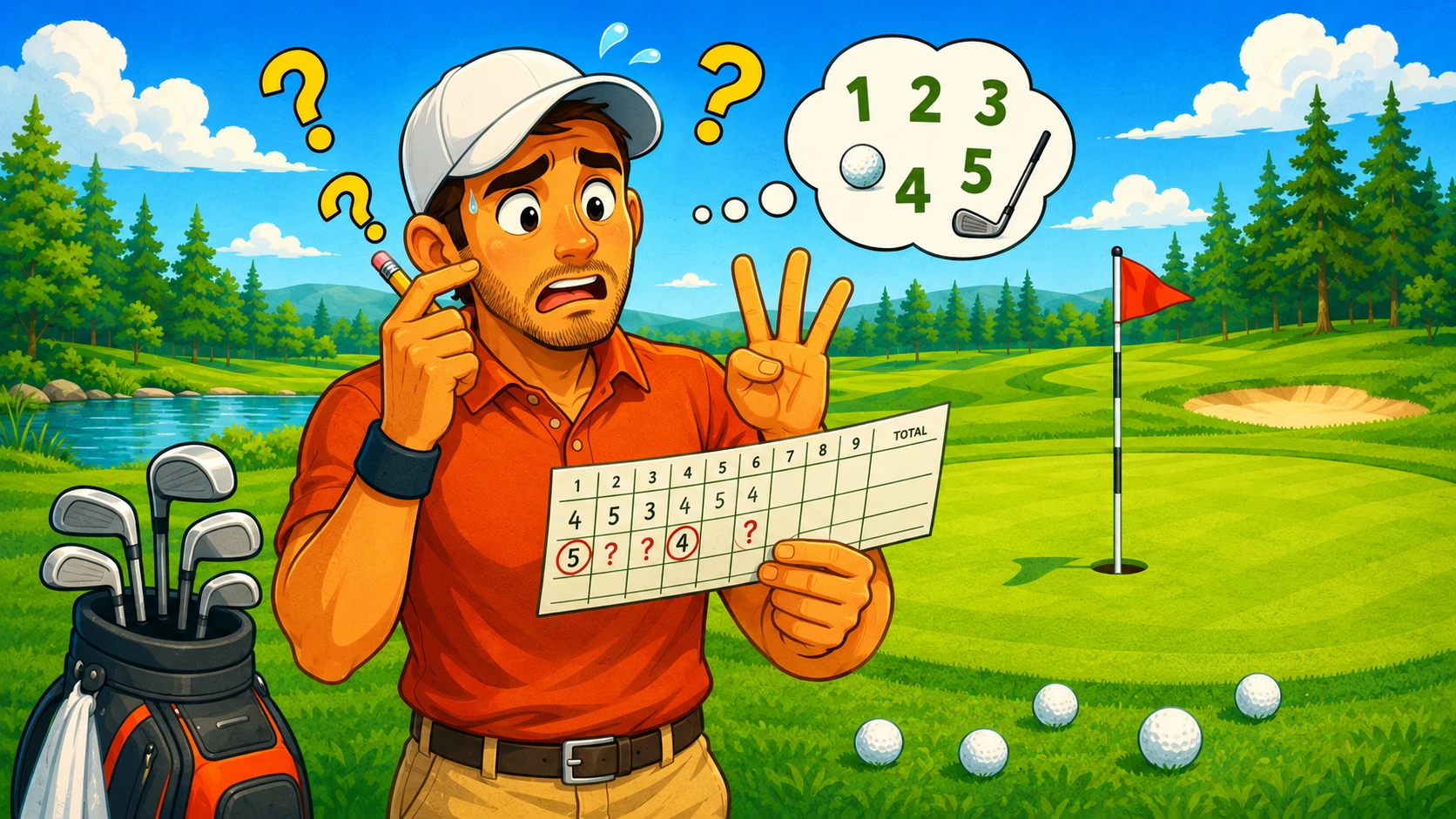
Golf scoring asks: how many strokes did you take to finish each hole? Count every stroke, including penalties, for your total round score. Familiar terms may seem confusing, but the system is straightforward.
Learn first, play smarter, and make every round easier to understand.
- Golf scoring is clearer when you compare your score for each hole to its par, not by memorising every term.
The simple idea behind golf scoring
In most sports, the highest score wins. Football, tennis, basketball, and handball all reward more points. Golf is different—the lowest score wins, since the score counts strokes used. Fewer strokes mean greater efficiency.
If you play one hole and need five shots to finish it, your score for that hole is 5. If your friend finishes the same hole in four shots, your friend has beaten you on that hole because four is lower than five. That is the core of golf scoring.
A round of golf usually has 18 holes, though some play 9. Record your score for each hole and add them up. If your 18-hole scores total 102, your gross score is 102. If they total 89, your gross score is 89.
Golf’s many scoring terms arise because golfers compare each hole’s score to its expected par, not just stroke count. Par is the standard for each hole.
What par means in golf
Par is the number of strokes a skilled golfer needs to complete a hole. It’s not a beginner target or a judgment, just the scoring standard.
Most golf holes are par 3, par 4, or par 5:
- Par 3: A shorter hole where a skilled golfer is expected to reach the green in one shot and then use two putts.
- Par 4: A medium-length hole where a skilled golfer is expected to reach the green in two shots and then use two putts.
- Par 5: A longer hole where a skilled golfer is expected to reach the green in three shots and then use two putts.
Par assumes two putts on the green. Reaching the green in the set number of shots and taking two putts makes par. For example, a par 4 expects two strokes to reach the green and two putts—totalling four. Par provides a standard for comparison, not a skill judgment.
With par explained, it’s useful to understand the main scoring terms used in golf.
These short terms quickly indicate a player’s performance compared to par.
Here are the most common scoring terms:
- Albatross or double eagle: Three strokes under par. Very rare.
- Eagle: Two strokes under par.
- Birdie: One stroke under par.
- Par: Exactly the expected score for the hole.
- Bogey: One stroke over par.
- Double bogey: Two strokes over par.
- Triple bogey: Three strokes over par.
Let us make that practical. On a par 4:
- Score 3 = birdie
- Score 4 = par
- Score 5 = bogey
- Score 6 = double bogey
- Score 7 = triple bogey
On a par 3, a score of 2 is a birdie, 3 is par, 4 is bogey, and 5 is double bogey. On a par 5, a score of 4 is a birdie, 5 is par, 6 is bogey, and 7 is double bogey.
Once you understand this, the terminology of golf scoring becomes clearer. For example, a score of five may represent a double bogey on a par 3, a bogey on a par 4, or a par on a par 5. The same score can have different meanings depending on the par. Each stroke is counted: tee shots, fairway shots, chips, bunker shots, and putts. Even a missed swing counts as a stroke.
Here is a simple example on a par 4:
- Shot 1: Tee shot to the fairway.
- Shot 2: Iron shot near the green.
- Shot 3: Chip onto the green.
- Shot 4: First putt close to the hole.
- Shot 5: Second putt into the hole.
Your score is 5. On a par 4, that is a bogey. Counting in small chunks helps: increment your count after each shot. On the green, know if you’re putting for par, bogey, or double. This supports both scoring and course management.
Another useful phrase is “in for”. If you are on the green lying 3, your next putt is “for 4.” If the hole is a par 4, that means you are putting for par. If you miss and tap in, you make 5, a bogey.
Penalty strokes made simple.
Penalty strokes are extra strokes added to your scoreAfter learning about scoring terms, it’s important to discuss situations that add stroPenalty strokes are extra strokes added to your score. After learning about scoring terms, it’s important to discuss situations that add strokes to your score. alty area. The basic principle is easy: a penalty adds strokes to your score even though you did not physically hit those strokes.
- Lost ball: If your ball cannot be found within the allowed search time, it is lost. In standard stroke play, you normally add a penalty and play again from where the previous stroke was made.
- Out of bounds: If your ball is outside the course boundary, often marked by white stakes or fences, you usually apply stroke and distance. If your tee shot goes out of bounds, your next tee shot is your third shot.
- Penalty area: If your ball enters a marked red or yellow penalty area, such as water, a stream or a ditch, you normally add one penalty stroke and drop under the correct relief option.
- Unplayable ball: If you find your ball but cannot reasonably play it, you may declare it unplayable, add one penalty stroke and take relief.
For beginners, it is not necessary to memorise every rule. Beginners don’t need to memorise every rule at first. Just know penalties add strokes, and ask a partner, coach, or club official for help when unsure. Even experienced golfers consult each other on rules. records scores for your round. Understanding its main parts makes it a practical tool for tracking your progress.
Most scorecards include:
- Hole number: The holes from 1 to 18.
- Yardage or metres: The length of each hole from different tee boxes.
- Par: The expected score for each hole.
- Stroke index: A ranking of hole difficulty used for handicap strokes.
- Player rows: Spaces where each player’s score is written.
- Out, in and total: Totals for the front nine, back nine and full round.
To use a scorecard, write your strokes for each hole in the correct box. Add up the first nine, then the back nine, then the total. A scorecard both records and helps analyse your game.
Front nine, back nine and total score
The first nine holes of an 18-hole course are called the front nine. The last nine are the back nine. The total for holes 1–9 is usually marked “Out”; holes 10–18, “In.” score. For example:
- Front nine: 51
- Back nine: 48
- Total score: 99
This approach is also beneficial for goal setting. For example, this approach also helps set goals. For instance, a golfer aiming to break 100 can try to average about 50 strokes per nine holes or minimise big scores. Golf scoring requires both arithmetic and strategy. A dicap system that allows players of different levels to compete more fairly. This is one of the great things about golf. A beginner, a high handicapper and a strong player can all play together and still have a meaningful match.
Your gross score is your actual score before handicap adjustment.
ent. If you take 104 strokes, your gross score is 104.
Your net score is your score after handicap strokes are deducted. If your gross is 104 and you get 30 handicap strokes, your net score is 74, according to the stroke index on the scorecard. The hardest hole has a stroke index of 1; the next hardest, 2; and so on. If you receive one handicap stroke on a hole, your net score for that hole is one lower than your gross score. If you receive two handicap strokes, your net score is reduced by 2.
For example, if you make 6 on a par 4 and receive one handicap stroke, your net score is 5. Your gross is double bogey, but your net is bogey. This lets golfers measure performance against their ability.plex. It is advisable to first become proficient in gross scoring. Once stroke counting, understanding par, and completing a scorecard are mastered, the principles of handicap scoring become more accessible.
Stableford scoring explained
Stableford is a widely used scoring format, particularly in club golf. Rather than summing total strokes, players earn points on each hole according to their net score relative to par. This system mitigates the impact of a single poor hole, as players may discontinue play on a hole once they are unable to earn points and proceed to the next.
A common Stableford points structure is:
- Net double bogey or worse: 0 points
- Net bogey: 1 point
- Net par: 2 points
- Net birdie: 3 points
- Net eagle: 4 points
Common beginner scoring mistakes
Scoring errors are common among beginners and typically result from confusion, excitement, stress, lost balls, or difficulty recalling the sequence of strokes, rather than intentional misrepresentation.
Here are common mistakes to avoid:
- Forgetting air shots: If you swing with the intention of hitting the ball and miss, it counts.
- Forgetting penalty strokes: Lost balls, out of bounds and relief situations often add strokes.
- Counting only “good contact” shots: Topped shots, duffs and tiny chips still count.
- Writing scores too late: Record the score before the next tee shot, while the hole is fresh.
- Mixing up gross and net: Write your actual strokes first. Handicap adjustment comes after.
- Not asking for help: Scoring and rules questions are normal. Ask before. It is beneficial for beginners to confirm scores with playing partners after each hole. This practice is standard in golf and helps prevent minor errors from accumulating or remaining unresolved.
A practical scoring example
Let us play a simple par 4 together. You hit your tee shot into the rough. That is stroke 1. You punch the ball back to the fairway. That is stroke 2. You hit an iron near the green. That is stroke 3. You chip onto the green. That is stroke 4. You take two putts. Those are strokes 5 and 6.
Your gross score is 6. On a par 4, that is a double bogey.
Now, let us say you receive one handicap stroke on that hole. Your net score is 5. Net 5 on a par 4 is net bogey. In Stableford, that would often be worth 1 point.
Now imagine the same hole with a penalty. You hit the tee shot into a red penalty area. The tee shot counts as stroke 1. You add one penalty stroke, so you are now lying 2. You drop a ball and play your next shot as stroke 3. From there, you hit onto the green in stroke 4 and two-putt for strokes 5 and 6. Your score is still 6, but the route was different because one of the strokes was a penalty stroke.
This is why golfers often say, “I made six with a penalty,” or “I made six after a chip and two putts.” The final number matters, but the story behind the number helps you learn.
Final thoughts
Golf scoring need not be intimidating. Begin by mastering the basics: count every stroke, understand par, learn the primary scoring terms, and record scores after each hole. Once these elements are familiar, incorporate penalties, handicap strokes, net scoring, and Stableford points.
The objective is not to achieve expert-level knowledge immediately, but rather to develop sufficient familiarity to participate, keep score, comprehend common terminology, and utilize the scorecard as a tool for improvement.
It is important to recognize that par serves as the reference point, bogeys are a normal aspect of play, penalties are integral to the game, and the scorecard is a valuable resource for tracking progress.
Acquiring familiarity with golf scoring terminology facilitates greater understanding, enjoyment, and improvement in the game.
Suggested next steps
- Start with the beginner golf overview
- Build skills with GolfBoosters theory courses
- Learn why theory-first golf makes practice easier
- Stay calm with The Mind Game
- Use simple choices to break 110
- Reduce wasted strokes and break 100
- Build consistency on the way to break 90
- Develop disciplined scoring habits for break 80
- See how GolfBoosters supports golf clubs
- Return to the basics before your next round