Which Tee Should You Play From? A Guide to Enjoying the Round More
Choosing which tee to play from sounds like one of the simplest decisions in golf. You arrive at the first hole, see several sets of markers, and think, “Right, I’ll just play from the normal ones.” Then the round begins. The first hole feels about 900 metres long, every bunker sits perfectly in your path, and by the fourth hole, you wonder whether golf is a sport or a punishment invented by very patient people.
The good news is, tee choice is not about pride, age, gender, or whether you “look like a real golfer.” It is about finding a round that suits your current ability, gives you realistic shots, and helps you enjoy the game. For beginners, this is one of the fastest ways to make golf less stressful.
In this guide, we will explain what tee boxes are, how they change the golf course, how to choose the right tee for your game, and how using different tees can become a smart practice tool. Understanding this will set the foundation for making confident decisions before every round. Because yes, the tee box is not just where the hole starts. It is one of the most powerful course-management decisions you make all day.
The right tee does not make golf “too easy.” It makes golf the right kind of difficult.
What tee boxes actually are
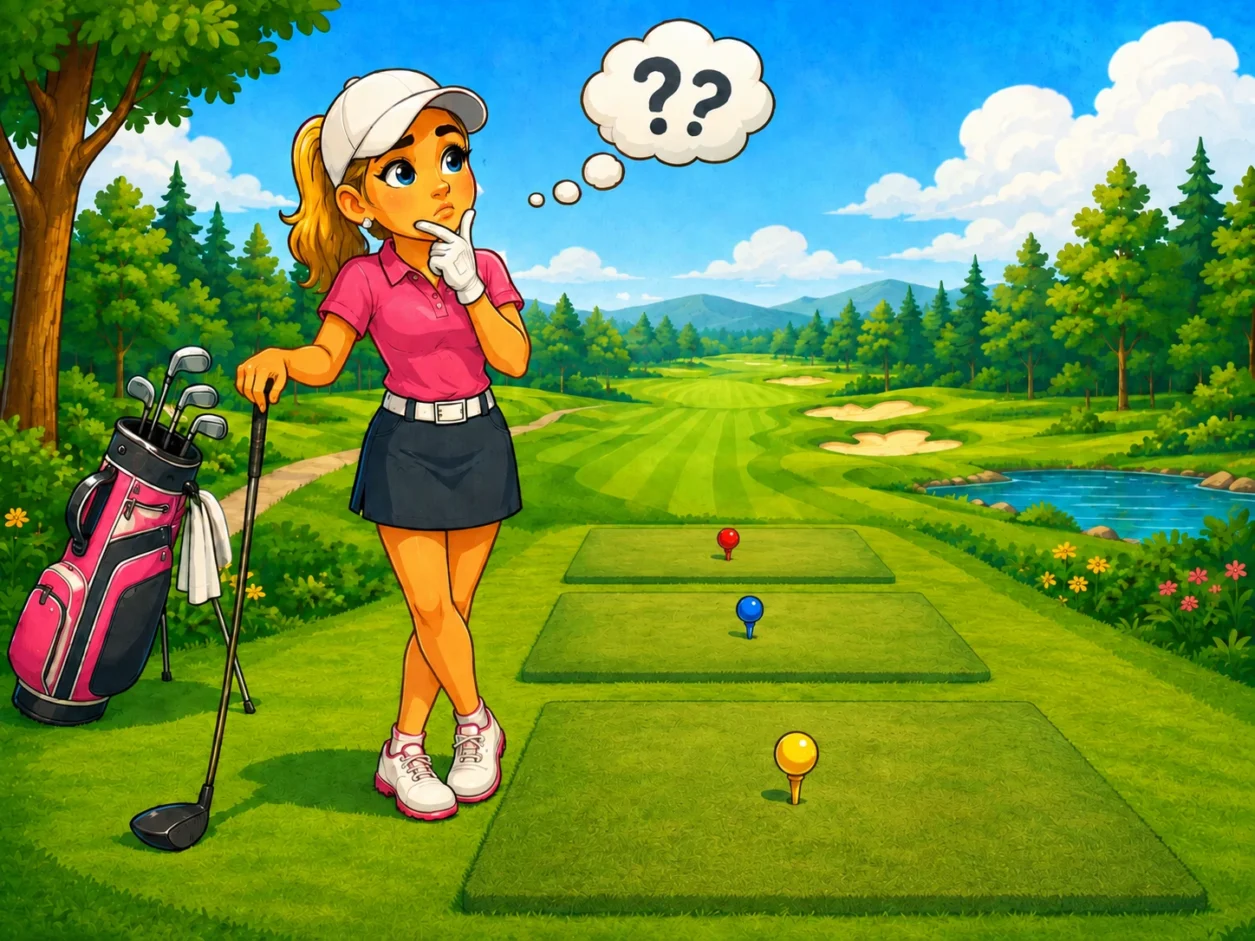
Every hole starts from a teeing area, often called a tee box. Most golf courses have several tee boxes on each hole. They are usually indicated by different colours, numbers, or yardage signs. Each set of tees creates a different total course length and a different playing experience.
Traditionally, many golfers thought of tees as “ladies’ tees,” “men’s tees,” “competition tees,” and “championship tees.” Thankfully, modern golf is moving away from that thinking. A tee should not be chosen because of gender or group influence. It should be chosen based on distance, skill, confidence, and your goals for the round.
Think of the tee box as the starting point of a puzzle. Move the starting point forward, and the hole becomes shorter; the hazards may play differently, and your approach shots become more manageable. Move it back, and the course becomes longer, more demanding, and less forgiving. Same hole. Different challenge.
Why tee choice matters more than beginners think
For beginner golfers, the tee box affects almost everything: how far you need to hit the ball, which clubs you use, whether you can reach the green in a sensible number of shots, how often you face forced carries, and how much pressure you feel on the tee.
If you play from tees too long for your game, every hole can feel like a rescue mission. You hit a driver, then a fairway wood, then another long club, and still may not be near the green. By the time you reach the short game, the scorecard already looks bruised.
Playing the right tee adds variety. You might hit a driver on some holes, a hybrid or iron on others, and shorter approach shots into greens. Suddenly, golf becomes less about endurance and more about decision-making—when the game becomes fun.
- You get more realistic chances to reach greens in regulation or close to it.
- You use more types of clubs, not just long ones.
- You face fewer impossible carries over water, rough, bunkers, or long waste areas.
- You reduce the pressure that causes tension and disaster swings.
- You keep a better pace of play because you spend less time searching and recovering.
Takeaway: Beginner-friendly tees keep golf challenging but fair, rewarding good decisions without removing the mental and physical puzzle.
How different tee boxes change the course
Many beginners think a tee box only changes distance. That is true, but it is only the beginning. Different tee boxes can completely change how a hole plays.
They change the length of every shot.
The most obvious difference is total length. A par 4 from the forward tees might be 290 metres. From the back tees, it might be 410 metres. That is not a small difference. For a beginner, it can be the difference between making a comfortable second shot toward the green and needing two or three more full shots just to get close.
Shorter does not mean silly. It means the hole is scaled fairly. Golf is more enjoyable when your approach shot is manageable, not a desperate long club from another postcode. Change the angle into the fairway.
Different tee boxes are often in new positions, not just distances. This changes the hole’s angle. A bunker that looks harmless from one tee could be in your target line from another. A dogleg may get easier or harder, trees can block one side more, and water may look closer or more intimidating.
Takeaway: Your tee choice shapes your experience. Consider length and challenge when picking a starting point.
They change which hazards matter.
Hazards are designed with certain landing areas in mind. From one tee, a fairway bunker might be safely out of reach. From another tee, it might be exactly where your good drive lands. A pond that requires a 150-metre carry from the back tee might only require 80 metres from the forward tee. Or it might disappear from the tee shot completely and only matter on the approach.
That means the same golf course can teach you different lessons depending on the tee you choose. One tee teaches you how to carry a hazard. Another teaches you how to lay up. Another teaches you how to pick a safer side of the fairway. This is why switching tees can be an excellent practice.
They change your club selection.
From longer tees, beginners often hit the longest club repeatedly—driver, fairway wood, hybrid, or long iron if they’re brave or optimistic. From shorter tees, you may use more mid-irons, wedges, and controlled tee shots, helping you choose clubs rather than always grabbing the biggest.
This matters because golf improvement is not only about hitting farther. It is about learning when distance helps and when control helps more.
They change your emotional experience.
This is underrated. A course that is too long can make a beginner feel behind from the first hole. That pressure creates tension, which leads to hurried swings. Rushed swings create strange ball flights that were not part of the plan.
Takeaway: The right tee relieves pressure and boosts enjoyment for beginners.
The common beginner mistake: playing too far back
The most common mistake is simple: many beginners play from tees that are too far back. Sometimes they do it because the rest of the group is playing there. Sometimes they think the forward tees are only for others. Sometimes they do not want to look inexperienced. And sometimes nobody explained that choosing a shorter tee is not a confession of weakness. It is course management. CK often creates a chain reaction. The tee shot becomes stressful because the hole looks enormous. The second shot is too long. The third shot is still not a wedge. The golfer starts forcing things. Then come the penalties, the lost balls, the three-putts born from frustration, and the classic beginner phrase: “I was actually playing quite well except for those two holes.”
Those two holes, of course, were not random. They were often the result of a course set-up that asked too much too soon.
Takeaway: Playing farther back doesn’t impress anyone. Prioritise course enjoyment and equity.
How to choose the right tee for your game
The right tee should give you a reasonable chance to play the course in a balanced way. You should not feel that every par 4 requires three perfect long shots before you even see the green properly. You should also not feel that every hole is a pitch-and-putt unless that is your practice goal for the day.
Start by looking at your average, normal distance, not your once-a-summer miracle shot. Golfers often remember the one driver that went forever with a tailwind, firm fairway, downhill bounce, and maybe divine assistance. That is not your planning distance. Your planning distance is the shot you can produce often enough under normal conditions. ask yourself these simple questions:
- Can I reach most par 4s in two or three sensible shots without needing a miracle?
- Do I have approach shots where I can use mid irons, short irons, or wedges?
- Can I carry the main forced carries without panic?
- Am I using only my longest clubs all day?
- Does the round feel challenging but still playable?
Takeaway: If most answers are no, choose a tee that fits your current ability to enjoy the round.
Simple distance guidelines for beginners
Golf courses vary, so no single formula works perfectly everywhere. Still, beginners can use a few practical guidelines.
Use your reliable driving distance, not your best one.
Takeaway: Use your reliable driving distance as a guide for choosing an enjoyable set of tees and experience the proper flow of the game.
If your reliable tee shot is 170 to 200 metres, you may be ready for a moderate course length, depending on your accuracy and how well you handle long second shots. If your tee shot is longer but very wild, do not automatically move back. Length without control is like owning a sports car with no brakes. Exciting but not always helpful.
Look at the par 3s
Par 3s are a great clue. If most par 3s require clubs you cannot hit reliably, or carries that make you tense, the tees may be too long. A good beginner-friendly tee should offer at least some par 3s where you can use a comfortable iron, hybrid, or even a controlled shorter club.
How different tee boxes help you practise
One of the best beginner lessons is this: you do not have to play the same tees every round. Different tee boxes are not only different levels. They are different classrooms.
Forward tees help you practise scoring.
Playing from the forward tees gives you more chances to hit shorter approach shots, chip from realistic positions, and putt for pars or bogeys instead of always trying to rescue double bogey. This is excellent for learning how to build a good hole.
When you play forward, you may discover that scoring is still not automatic. You still need to hit fairways, choose good targets, control wedges, and avoid silly mistakes. That is valuable. It teaches you that lower scores come from better decisions, not just shorter holes.
Why forward tees improve course strategy
Some golfers think forward tees are only for beginners. In reality, forward tees can be brilliant for learning strategy. When the hole is shorter, you are often closer to the green in fewer shots. That means you face more realistic decisions: where to land the approach, which side of the green is safer, when to chip aggressively, and how to leave an uphill putt.
From tees that are too long, beginners often do not get to practise those decisions because they are still far away after several shots. Forward tees bring the scoring parts of the game into play earlier. That is good training.
Forward tees also teach restraint. On a short par 4, do you really need a driver? Maybe an iron or iron leaves a perfect wedge. Maybe the fairway bunker only matters if you choose the wrong club. Maybe the smart shot looks boring, which is often golf’s way of whispering, “Well done.”
- Use forward tees to practise hitting greens with shorter clubs.
- Use them to work on wedge distance control.
- Use them to practise making pars without hero shots.
- Use them to learn where not to miss around the green.
- Use them to build confidence before moving back.
When should you move back?
Move back when your current tee regularly feels playable, not after one good round. One good round is encouraging, but not a legal document. Before moving back, look for patterns. You may be ready to try a longer tee when you can keep the ball in play more often, reach or nearly reach many greens in regulation, carry the main hazards comfortably, maintain pace, and finish rounds feeling challenged rather than crushed.
FAQ: Choosing the right tee box
Should beginners always play from the forward tees?
Many beginners should start from the forward tees, but “always” is too strict. The best tee depends on your distance, accuracy, confidence, and the course layout. Forward tees are often the best starting point because they make the course more playable and help you learn scoring.
How do I know if a tee is too long for me?
If most holes require several long shots before you can even think about the green, if forced carries feel impossible, or if you spend the whole round using only your longest clubs, the tee is probably too long for your current game.
Final thoughts: Choose the tee that lets you play golf, not just survive it
The tee box is not a small detail. It shapes the entire round. It changes the distance, the angles, the hazards, the clubs you use, the decisions you face, and even how confident you feel standing over the ball.
For beginners, choosing the right tee is able to transform golf from a long battle into an enjoyable learning experience. You will still make mistakes. You will still hit the occasional shot that makes you stare at the clubface as it betrays you. That is golf. But from the right tee, the course gives you a fair chance to recover, learn, and enjoy the walk.
So next time you arrive at the first hole, do not ask, “Which tee is the proper one?” Ask, “Which tee gives me the best chance to play smart, learn something, and enjoy this round?” That is the tee you should play from.
Suggested next steps
- Start with the beginner golf overview
- Build skills with GolfBoosters theory courses
- Learn why theory-first golf makes practice easier
- Stay calm with The Mind Game
- Use simple choices to break 110
- Reduce wasted strokes and break 100
- Build consistency on the way to break 90
- Develop disciplined scoring habits for break 80
- See how GolfBoosters supports golf clubs
- Return to the basics before your next round