Golf Terms Explained — A Beginner-Friendly Glossary of the Words Golfers Use
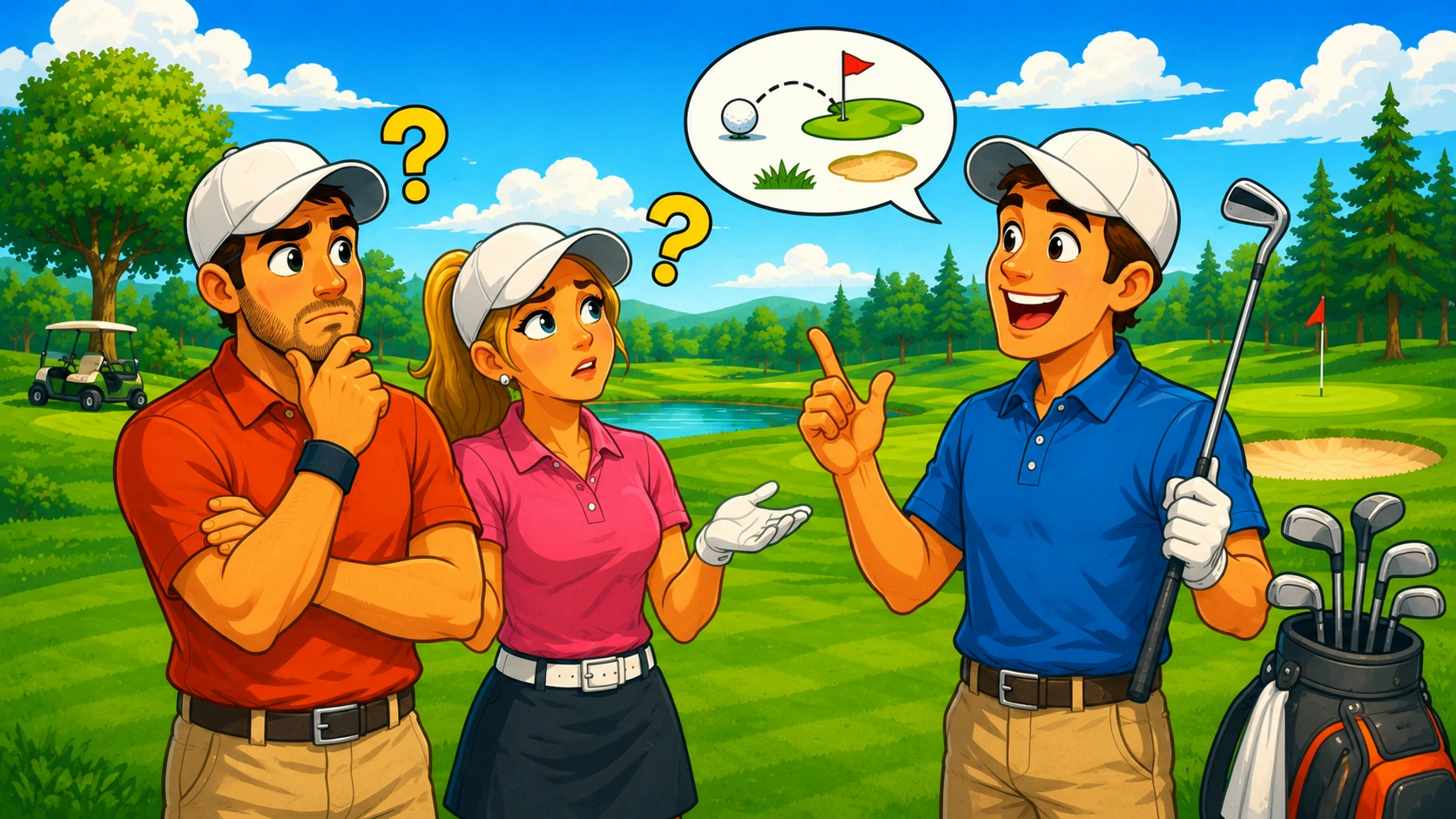
Golf has its own language. If you are new, it can sound like math, weather reports, gardening, and civil panic rolled into one.
If someone says they “pushed a provisional into the rough, took relief, then three-putted for double,” everyone nods. You smile and quietly wonder, “Was that good or bad?”
Don’t worry—every golfer has been confused at first. Golf terms make sense when explained simply. Experienced golfers often forget how strange these words sound to beginners. They name lies, fade, draw, and “pin high”, assuming everyone to understand.
This guide is for beginners who want to follow conversations across the course, lessons, clubhouses, TV, and after rounds. It won’t make you a rules expert, but it will give you the vocabulary to feel comfortable, ask smarter questions, and enjoy the game.
Golf becomes much less intimidating when the words start making sense.
Why golf terms matter for beginners
You don’t need every term. Learning key golf words helps you understand instructions, make better choices on the course, and feel more at ease with other golfers.
- You understand instructions better. When a coach says “play it back in your stance” or “take one club more,” you know what they mean.
- You make better decisions on the course. Understanding phrases such as ” hazard, relief, out of bounds, and provisional helps you stop confusion and penalty strokes.
- Golf is social. Knowing the language lets you join conversations rather than feel lost. The aim is comfort, not cleverness. Golf is already tough enough without decoding every sentence.
Golf course terms
A standard golf course has 18 holes, though many also have 9-hole or practice layouts. Each hole includes distinct areas with their own names.
Tee box or teeing area
The teeing area is where you start each hole. Many golfers call it the tee box. This is the only place on the hole where you are normally allowed to place your ball on a tee. Different tee markers show different starting distances, often arranged by colour.
Fairway
The fairway is the short grass running from the tee to the green. This is where the ball should go, but beginners often only cross it to reach their ball elsewhere.
Rough
The rough is the longer grass beside the fairway and green. It makes shots harder but calls for simpler play.
Green
The green is the very short, smooth grass around the hole where you putt. The goal is to get the ball into the hole in as few strokes as possible. Greens can slope, break, run fast or slow, and sometimes make you question your choices. The apron is the slightly longer grass around the edge of the green. You can often putt from the fringe, but you may also choose to chip depending on the lie and the distance.
Bunker
A bunker is a sand hazard. Greenside bunkers are near the green; fairway bunkers are farther away. Bunkers look nice in photos, less so when your ball is inside.
Penalty area
A penalty area is usually water or a marked area where special relief rules apply. Markers are often red or yellow.
Out of bounds
Out of bounds, or OB, means outside the course boundary. It is usually indicated by white stakes or fences. If your ball is out of bounds, you must play again from the previous spot with a penalty. In beginner terms, it is not ideal. It is trouble.
The pin or flagstick marks the hole’s position on the green. Golfers often say, “The pin is at the back” or “Aim for the middle, not the pin.” The hole can refer to the physical cup on the green or to the entire playing area from tee to green.
Scoring terms
Golf scoring is simple: count all strokes. Fewer strokes are better. Each hole has a target called par.
Par
Par is the expected strokes for a hole—usually 3, 4, or 5. Par 3 is shorter, par 4 is medium, and par 5 is longer. Par provides a scoring reference.
Birdie
A birdie is one stroke under par. On a par 4, that’s 3 strokes. Birdies are rewarding and keep golfers coming back.
Eagle
An eagle is two strokes under par. On a par 5, that’s 3 strokes. Beginners rarely make eagles, barring luck or surprise.
Bogey
A bogey is one over par. Beginners and high-handicappers should be content with bogeys from sensible play.
Double bogey and triple bogey
Double bogey is two over par; triple bogey is three. Beginners will make them. Avoid turning one mistake into more.
Stroke
A stroke is
One attempt to hit the ball counts as a stroke, even if it only moves a few inches. Golf is honest that way.
Gross score and net score
Your gross score is the number of strokes you took. The net score is after handicap adjustments to level the playing field.
Shot terms and ball flight words
Golfers often describe shots by shape, height, or quality—sometimes usefully, sometimes as dramatic storytelling. Here are the most common terms.
Drive
A drive is the first shot on longer holes, usually from the tee with a driver or long club. For beginners, a good drive stays in play for another shot.
Approach shot
An approach shot is played toward the green, with any club, trying to get close.
Lay-up
A lay-up is a safe shot short of danger or the green. It’s good course management and may save strokes.
Slice
A slice is a shot that curves strongly away from the player’s dominant side: right for a right-handed golfer and left for a left-handed golfer. It is one of the most common beginner ball flights and can be caused by issues with the clubface, swing path, grip, or setup. A hook curves strongly in the opposite direction—a right-hander’s hook goes left. Hooks can go very far, but not always where the golf course designer hoped you would go.
Fade
A fade is a controlled, gentle curve to the right for a right-handed golfer. A slice is usually unplanned. A fade is intentional or at least friendly enough to return. A draw is a controlled, gentle curve to the left for a right-handed golfer. Many golfers love the idea of hitting a draw because it often looks powerful and rolls well, but beginners should focus on predictable contact before chasing stylish curves.
Push and pull
A push starts right (for right-handers) and stays right; a pull starts left and stays left. Unlike slices or hooks, the ball doesn’t curve much; it just starts off line.
Thin shot
A thin shot happens when you strike the ball too high, often near the lower edge of the clubface. It usually flies low and fast. Around the green, a thin shot can turn a delicate chip into a missile.
Fat shot
A fat shot occurs when the club hits the ground before the ball, resulting in a much shorter shot. Also called hitting heavy or behind the ball.
Top
A top is when the club hits the upper part of the ball, sending it rolling along the ground. It’s annoying, but it usually moves the ball forward, which sometimes counts for beginners.
Short game and putting terms
The short game covers shots near the green, where many strokes are saved, and personalities emerge.
Chip
A chip is a low, short shot played around the green. It spends more time rolling than flying. Beginners should learn chipping early because it is simple, useful, and often safer than trying to lift every shot high into the air. A pitch is a longer short-game shot that spends more time in the air, useful for getting over a bunker, rough, or slope if you need the ball to land softly.
Bump-and-run
A bump-and-run is a low shot that lands early and rolls toward the hole. It is beginner-friendly because it uses the ground as a helper. When in doubt, many golfers should choose less air and more roll.
Flop shot
A flop shot is a very high, soft shot played with an open clubface. It looks wonderful when specialists play it and ridiculous when beginners try it without practice. Learn the basic chip and pitch first.
Putt
A putt is a rolling shot played on the green with a putter. The putter may look simple, but putting is a complete skill that involves distance control, green reading, start line, and patience.
Green reading
Green reading means judging the slope and speed of the green to predict how the ball will break. “Break” is the curve of the putt as it rolls over slopes.
Three-putt
A three-putt means taking three putts on one green. It is common for beginners and painful for professionals. Good distance control is the best cure.
Up-and-down
An up-and-down means getting the ball into the hole in two strokes from around the green: one chip or pitch and one putt. It is a great skill and a realistic goal for improving golfers.
Rules, penalties and relief terms
Rules language can feel intimidating, but beginners only need a practical foundation at first. The most important thing is to know when to ask for help before moving your ball.
Penalty stroke
A penalty stroke is an extra stroke added to your score because of a rules situation, such as a lost ball, a ball in a penalty area, or taking certain types of relief.
Relief
Relief means you are allowed, or sometimes required, to move your ball from a specific situation under the Rules of Golf. Relief may be free or may cost a penalty stroke, depending on the situation.
Free relief
Free relief means you can move the ball without penalty. Common examples include interference from a cart path, sprinkler head or certain abnormal course conditions. Always check the correct procedure before dropping.
Drop
A drop is the method used to put a ball back into play when taking relief. Modern drops are from knee height. The ball must land and come to rest in the correct relief area.
Lost ball
A lost ball is one that cannot be found within the allowed search time. If you think your ball might be lost outside a penalty area, you should usually play a provisional ball to save time.
Provisional ball
A provisional ball is a second ball played when your original ball may be lost or out of bounds. You must announce it as provisional before playing. This can prevent a long, awkward walk back to the tee.
Unplayable ball
An unplayable ball is when you decide your ball cannot reasonably be played as it lies. You can take penalty relief. This is often smarter than trying a miracle shot from bushes, roots, or deep rough. Handicap and competition terms
GGolf has a handicap system that allows players of different levels to compete fairly. That is one of the best things about the game: a beginner, a decent club golfer, and a low-handicap player can all enjoy the same round together. Handicap
A handicap represents a golfer’s playing ability. The higher the handicap, the more strokes the player receives for net scoring. It is not a label of shame but a tool that makes golf fairer.
Stableford is a scoring format where you earn points on each hole based on your score relative to your handicap. It is beginner-friendly because one bad hole does not ruin the entire round. You can pick up and move on when you no longer score points.s.
Match play
Match play is a format where you compete hole by hole. Winning a hole matters more than total strokes. A disastrous hole only loses one hole, not the whole match.
Stroke play
Stroke play means all strokes count toward a total score for the round. This is the format many people think of as normal golf scoring.
A mulligan is an informal do-over shot.
It is not part of the official rules, but amicable groups sometimes allow it for fun. Use with care. Too many mulligans and you are no longer playing golf but editing history.y.
How to learn golf language faster
You do not need flashcards, a whiteboard, or a dramatic study schedule. The best way to learn golf terms is to connect each word to a real situation.
When you hear a term in the course, ask what it means. Most golfers are happy to explain, especially if you ask before the shot instead of after your ball has disappeared into a protected nature reserve.
Here is a simple learning method:
- Start witStart with course areas. Learn tee, fairway, rough, bunker, green, fringe, penalty area, and out of bounds. ring words. Learn par, bogey, double bogey, birdie, stroke, gross and net.
- Learn your own shot patterns. If you slice, top, or hit fat shots, learn those words first because they describe your reality. He explains the rules and terms slowly. Focus on lost ball, provisional, relief, drop and penalty stroke.
- Use the words during practice. Say “I am going to chip this low” or “I am laying up short of the water.” Language becomes easier when connected to decisions.
The goal is not to impress experienced players but to reduce confusion so you can focus on playing. Golf rewards calm thinking. Understanding the language makes calm thinking easier.
FAQ: Golf terms for beginners
What are the most important golf terms for a beginner to know?
Start with tee, fairway, rough, green, bunker, par, bogey, penalty area, out of bounds, chip, pitch, putt, lost ball, provisional and handicap. These words appear constantly and help you understand both play and scoring.
What does “lie” mean in golf?
Your lie is how the ball sits on the ground. A good lie means the ball is easy to strike. A bad lie might mean the ball is sitting down in rough, on a slope, in sand, behind a root or against thick grass.
Final thoughts: golf words are tools, not tests
Golf terms can feel confusing at first, but they are not there to keep beginners out. They are simply tools for describing what happens in the course. Once you understand the language, golf becomes easier to follow, discuss, and learn. If you still mix up a pitch and a chip, or if you need to ask whether a red-staked area means a penalty area. That is normal. Every experienced golfer once had to learn these words too, even the ones who now say them with great authority while looking for their ball in the trees.
Start with the most useful terms. Use them in real situations. Ask questions. Laugh when golf sounds ridiculous. Then keep playing. The more the language makes sense, the more the game itself opens up.
Learn first. Play smarter. Have more fun.